METRIC WEEK – A Simple Bar Chart

1 Comment

This week on engineeringdaze.com, we will pull together in one week some of the posts that were written to inform and to promote the metric system, an incredibly obviously superior system of measurement to the one we here in the United States use.

Hoping you all are not like my coworker, “Wade”, who understands that the metric system is a decimal system, but doesn’t get the point of decimals…


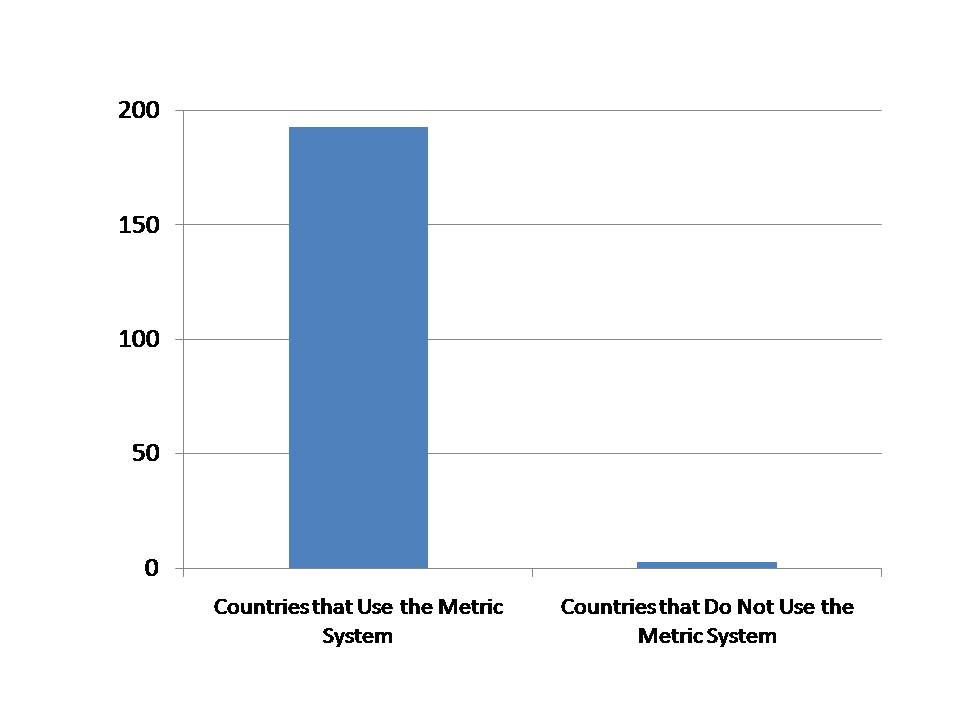
Here is a simple bar chart that says it all from the perspective of most engineers.

The Number of Countries that Use the Metric System vs. the Number of Countries that Do Not Use the Metric System

If you didn’t know, the USA is represented on the right, one of the three countries that does not use the metric system. There are approximately 193 countries (depending on how one counts countries) that do use the metric system.

It’s us, and our friends in Liberia and Myanmar.

Nuff said.

Algorithms To-Do List

Leave a comment

All engineers have, whether in their head or written down somewhere, a to-do list of algorithms. This is a list of things that will make life easier, more efficient, and, well, just plain fun to live, if he, the engineer, would only be able to develop an algorithm to explain and better understand that thing on the list. The key is to use his engineering skills to improve his life.

Here are five of them that are common to engineers. Listed are the topics and then some haphazard notes that the engineer has made to help get this algorithm running smoothly.

In no particular order:
Algorithm To-Do List

1. Optimize commute to and from work – need to collect traffic and signal timing data for all streets within 10-mile corridor or normal commute route; have to purchase and run traffic modeling software

2. Efficient car packing for vacation – measure all luggage to .1 cm; get accurate height and weight measurements of all family members; need precise measurements of interior of car, model in 3-D software and optimize packing

3. Temperature of house vs. complaint level/rebellion of family – get more thermometers; create measurement scale for family member axis; conduct summer and winter temperature trials; plot

4. Efficiency of excuses to avoid time with relatives – brainstorm and/or google list of excuses; rate; utilize top 5 excuses with promise at least 3 times each; chart results

5. Understand wife – what does she want; clueless here; move to long range algorithm goal

The Height of a Child

1 Comment

To measure the height of a child as he or she grows, the engineer will make sure it is accurate. That is his job.

This may involve some whining from the child and a few smart comments from his wife, but to get a measure in which one can be confident takes a little work. This means don’t rely on those doctor office contraptions. I have never trusted them. The nurse has the kid stand up on them, may tell them to stand up straight, may not, and then flops this metal arm on their head that may or may not be horizontal. Engineers do not appreciate flippant approaches to measurement.

The way to do this correctly is to get a straightedge that is also a level, the kind with the bubble in the glass cylinder. Have the kid stand straight as they can against a wall and place the level on their head, making sure it is, well, level. But how straight the kid stands and where the level hits on their uneven heads, along with possibly a few other variables, will not assure this to be an accurate measurement. So, here is the key. Take the measurement numerous times. I will not tell you how many, but it is more than two. Have the kid step away from the wall, then back against it, and place the level on his or her head and make a mark – and do this many, many times. You will then see that the field of measurement, particularly when a variable like a child is involved, is not an exact science. But at least with a number of measurements, you will see that their may be a few outliers, but many of the marks will be bunched together very closely and the average of those can be taken as the best measurement of the child’s height.

By the eighth time or so, the child may complain about stepping away and standing up again. Remind them that is only done once a year, or if you really like tracking height progression, once every month, and also remind them of the confidence he or she can have in “knowing” how tall you are (in English and metric units), rather than a sloppy, “Yeah, I’m about 4 feet 8 inches that friends who rely on that doctor office measurement can only say.

I think I’ve proved my point here.

3

Leave a comment

The number 3 is a hidden number of importance for the engineer. That means that the engineer may or may not consciously think of it as an important number, but it is important, nonetheless. I say that mostly to be able to use the word, “nonetheless”.

Anyway, 3 is the minimum number of estimates an engineer will want to be “comfortable” with a decision on buying an item. The item may be a new car, a computer, or a sandwich. The word “comfortable” is in quotes because we need to remember that this is not an emotional “comfortable”, rather one of having a sense that things are right. In that way, it is a logical “comfortable”.

The way an engineer thinks of this concept of 3 is the following: Getting one quote is just plain wrong. The seller can raise the price and you would never know, thus ripping you off. Having two quotes, well, that is better, but if they are quite different from each other, it is difficult to know what the true value is. Having 3, and here I should say at least 3, the engineer has a great chance of seeing either all three estimates bunch up together, or two be close and the third be the outlier. Outliers are bad. Consider the word itself, a combination of “out” which is negative, and “lier” which sounds like “liar”, also negative.

Having 4 or 5 or 6 estimates is better, but running around getting all those quotes gets somewhat wasteful at some point, and making sure it is the same product with the same features gets more difficult the more comparisons one makes. So the engineer is “content” (a logical content) with getting 3 quotes. This is helpful if shopping with an engineer, particularly if you are a spouse who thinks just walking into one car dealership and buying the first car you like (especially if color is one major factor) is the way to go…

a = dv/dt

Leave a comment

Engineers love equations. Whether for understanding women or understanding laws of motion, equations are incredibly useful for making sense of the world. Another fabulous equation (this more from the laws of motions rather than understanding women) is:

a = dv/dt

where,

a = acceleration

dv = change in velocity

dt = change in time

Acceleration should be broken down into its vector components for a typical x-y-z coordinate system. This means that each direction of the coordinate space has its own acceleration, as well as its own velocity and distance.

Here is where teaching children is fun. Drive down the road and keep the car going at a constant speed of say, 40 mph. Keep the speedometer saying 40 while you take a curve and then ask your child if you are accelerating. Most children will fall for the trap and will say no. They think that since the speed is 40 mph and that stays constant, then the car is not accelerating. But acceleration is a measure, not of a change in speed, but of a change in velocity in a direction. So, if the car stays at a a speed of 40 mph, on a curve it is actually increasing its velocity in the direction perpendicular to the original direction. The original velocity in that direction was zero. Now it is something. Acceleration has occurred. At the same time the velocity in the same original direction has actually gone down, so we have negative acceleration, commonly called deceleration, happening in that direction.

Trust me, I could go on. But, as a parent, I wish not to embarrass my kids any more than I have to. They should know how the world really works, but not be humiliated – completely.

The Interview

Leave a comment

I am not changing jobs, or even considering it. But I had an interview the other day.

I was interviewed by a high school kid who was taking a class where he was given the assignment of interviewing an engineer in order to find out what engineering was all about. This was to give the students some ideas about what areas of engineering exist and whether they may want to go into engineering themselves.

I wish to report that I did not disappoint the engineering community. I regaled him with stories of engineering – standards, spreadsheets, design issues, and statistics. Anyone would have been in awe.

This student had the wonderful opportunity that few school kids get, but many should experience, that of sitting down with an engineer and hearing about the wonderful world of engineering. All students should be able to learn that bridges are beautiful, electrical circuitry is exciting, HVAC systems are cool, and wastewater treatment plants simply rock.

He left with an amazed look in his eyes. Or it could possibly have been a disbelieving-crazed-bored look in his eyes. I can never tell those two apart.

I guess we will see how successful I was as a spokesperson for engineers in a year or so when it is time for him to apply for college. Then we will see if he puts in his application to fine engineering school, or some place that’s all fru-fru and artsy.

I can’t wait.

You Might Be an Engineer If…

4 Comments

– you enjoy the commute to work because it gives you time to calculate benefit/cost ratios for all the decisions that must be made at home (and so prove that buying a new car when the old breaks down no more than three times a year is not a wise choice).

1.0

Leave a comment

When an engineer makes a decision, from which car to buy to how long to stay at a relative’s house, he will do a benefit/cost (b/c) analysis. We have discussed this before on engineeringdaze.com.

We may also have mentioned the importance of the number 1, more precisely 1.0, to include the significant digit to the tenths. Today, we will emphasize this. We could take this to the hundredth or the thousandth or the millionth, but for most simple calculations, the tenths or hundredths will do. For now, we will keep to tenths.

What makes this number important to the engineer is that it is the tipping point, or the figurative line in the sand for the engineer when making a decision. If a b/c calculation results in a number greater than 1.0, then the activity is worth doing. Again, this can be from buying a roll of toilet paper to driving to the store for Tylenol because one of his kids “says” they have extreme pain from a baseball hitting their shin.

The difficult aspect about calculating a b/c ratio is that frequently either the benefit or cost is not easily quantifiable. If everything was given a monetary value, that would make life easy. But how do you measure the amount of whining of a kid with shin pain? How would one measure the annoyance level of spending time at the house of the relatives? How about the cost of sleeping on the couch rather than in bed if one decides not to buy flowers for an anniversary?

Fortunately, engineers are very creative when it comes to putting value on things. In highway safety engineering, we put a value on human life. If that is the case, and it is, then we certainly can place a value on the whining level of a kid with a hurt shin, or the pain level that kid supposedly is enduring. And when we place a value on the benefit and the cost, it is a simple matter to find the b/c ratio and decide, quite logically, that, say, maybe flowers aren’t waste of money.

It all has to do with 1.0 – is the b/c greater than or less than this. Life can be no simpler.

The Cost of Dry Hair

Leave a comment

My wife was riding with me in the car. She had just washed her hair and didn’t have time to dry it, so she opened a window and started to wind-dry her hair. She made the comment that this was saving all that money using the hair dryer. (It was a nice day.) She then stopped and wondered how much it did save.

So, to run the numbers, as an engineer will always want to do:

C = kW x t x r

where,

C = cost of electricity of using the hair dryer for one hair drying event, calculated in cents

kW = kilowatts used by the hair dryer

t = time of hair dyer use, in hours

r = rate of electricity cost, in cents per kilowatt-hour

For us, r, in the range of our confusing electric company’s tiered charges is around 5.5 cents per kilowatt-hour. The time, according to my wife (although I could have disputed this, from personal observation) would have been 5 minutes, or 0.0833 hours. The electric use rating of the hair dryer is 1875 watts, or 1.875 kilowatts.

So, we have:

C = 1.875 x 0.0833 x 5.5 = 0.86 cents

What I thought was that she obviously was not doing a full cost comparison between the cost of using a hair dryer. My calculation is only for the use of the hair dryer. But what about the extra cost of gas to propel the car with the added wind drag? On the other hand, there should be calculations made for the increase in air conditioning to cool down the home with all the heat added by the hair dryer. Then, there are the possibilities and the risk being taken that my wife will not hit her head on while we pass a branch, or a bird, or that she will not get chilled and get sick from drying her hair in the chilled air. This would involve probability and risk calculations.

When it comes down to it, it is just easier to dry her hair at home with the hair dryer.
Anti-Questions

Leave a comment

If an engineer goes out to the store with his non-engineer wife, there are a few things the wife has learned (hopefully) never to ask. They could be considering the purchase of a car or computer or a set of dish towels, it does not matter.

She likely has learned not to throw these questions out there from experience – long, slogging, arduous experience. Here are a few of the key questions not to ask. We will call them anti-questions.

Doesn’t that color look pretty?

What do you feel about this?

How about we splurge a little?

His wife might as well be speaking some Sumerian. The engineer will have no idea how to respond to the first two, and will easily respond to the last question with a resounding, “That would not be wise use of our funds.”

Engineeringdaze.com brings marital help to all engineers and their spouses.

You are welcome.

Older Entries Newer Entries