The Equation for Dating

Leave a comment

With equations, the engineer can figure things out. He may set up an equation something like this:

P = 100 x 0.0034(p1 + p2 + p3)

where,

P = Likelihood, in percent, that a woman will go out with him

p1 = Likelihood, as a fraction of 1, that he (the engineer) will decide to ask her out 

p2 = Likelihood, as a fraction of 1, that he (the engineer) will actually ask her out when he talks to her

 p3 = Likelihood, as a fraction of 1, that when he (the engineer) will talk that she actually understands that he is asking her out

In the engineer’s mind, the values of the three variables on the right side of the equation are typically:

p1 = 0.2                         p2 = 0.4                              p3 = 0.2

p1 is obviously low because the engineer knows the value of the other two variables. This may be as high as 0.3 for the confident, “outgoing” engineer

P2 is somewhat higher since, even though it is less than half the time, it is more likely that he will say the words in his mind than decide to say them, especially if he writes it out.

P3 is again quite low, mainly due to the fact that if the engineer will, as some may, start the discussion with an equation as to why the girl may want to go out with him, he typically loses her when he pulls out the calculator.

The 0.0034 value represents what an engineer sees as the probability that this girl, any girl, will actually say, “Yes”. Quite low, indeed, but at least it’s not negative. It is important to see where the engineer makes a mistake – easy to do when it comes to matters of the heart. He only calculates that there is a little over 1/3 of one percent chance that at that point she will actually say yes. This is not 33 percent chance, but well under 1 percent we are talking about here. But the engineer vastly underestimates this. Depending on the circumstances, this number is actually between 40% and 70%. Yes, that high. Some of these women have seen McGyver, too, and many are thinking, “Hmmmm, maybe.”

So we see that the process is much more involved than a silly musing of whether to ask a woman out. There are calculations to make, probability estimations to determine, equations to derive. And, yes, I realize that we are talking about relationships. But this is relationship theory done the engineer way.
Public Speaking – Not for Engineers

Leave a comment

It is no secret that engineers do not do well, as a whole, in public speaking. Anyone who has slept, make that sat through a presentation where an engineer has shown slide after slide of data that cannot be read, let alone fully understood, knows what I mean. Monotone does not help, either.

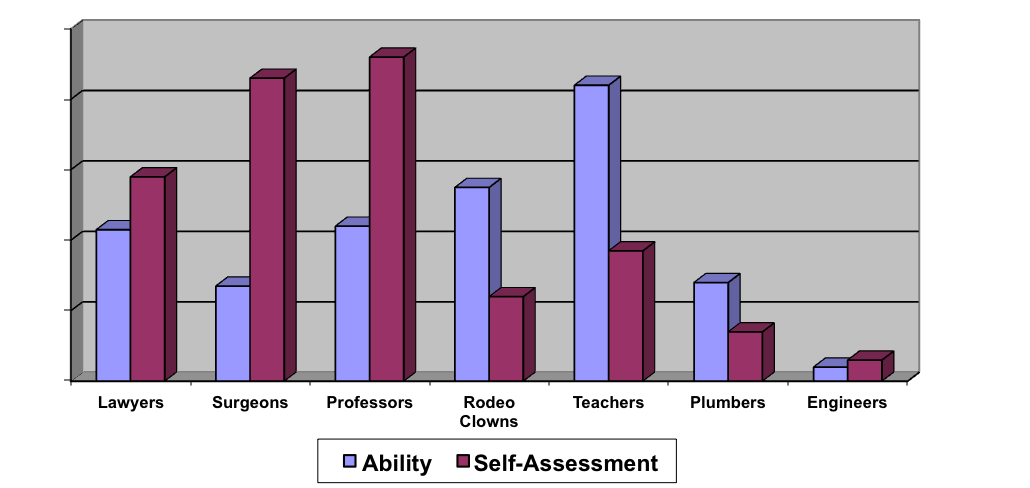
From our files of extrapolated data (meaning we didn’t actually measure anything, but it is likely good data from our perception), we see a bar chart with various professions and their level of ability in public speaking vs. how they perceive themselves. Here is the chart:

Comparing Different Professions on Their Actual Ability vs. How They Perceive Their Public Speaking Ability

Here are a few notes regarding this graph:

– Lawyers, Surgeons, and Professors are far better at public speaking than engineers, but they think they are far better than they are.

– Teachers are generally very good at public speaking, but lack confidence.

– Engineers, although very close in their perception of how they make presentations, are, in technical terms – BAD.

– If you ever get a chance to see a rodeo clown talk, take it.

The First Engineer – Engineering Hunting

Leave a comment

This week at engineeringdaze, we are going to follow the exploits of the first engineer, the caveman named Tork. Tork was so advanced for his era, being an engineer, that he was frequently shunned by other cavemen. But that is another story. For now, we look at how Tork engineered hunting.

It was common for cavemen to get food by luring a tasty animal under a cliff and drop a rock on it. Unfortunatley, if they did not kill the animal, the animal would try to kill them, but, that was life as a caveman. It was Tork that worked out the relationship between how high the cliff was, and how effective it was at killing the animal, the food. He measured height (how hi) in Torks, essentially his own height. He then looked at the effect of the rock he dropped. When the animal (Fud) was not hurt, or not hurt much, the consequences to Tork were bad. When the Fud was hurt bad, Tork could either drop another rock on it, or hit it many times with a club. He worked out how many times later. Tork came up with the table below, thus engineering how to hunt for food, or Fud. It did not take him long to find out that he would only ever drop a rock on an animal from a cliff three times his height, and preferably, five times his height. Later, he would add a factor of safety and only ever drop the rock from 8 Torks high, but Tork hadn’t worked through that Factor of Safety issue, as engineers these days are so comfortable with.

Unfortunately, scientific and engineering journals were not yet invented and his findings were slow to catch on, which was OK, because his spelling was terrible.

how  hi end up with
1 Tork Fud Not Hurt, Fud Hurt Tork
2 Torks Fud Hurt, Tork Run Away
3 Torks Fud Hurt Bad
4 Torks Fud Hurt Bad
5 Torks Fud Ded

Factor of Safety

Leave a comment

A great way to understand the engineer’s interest in living life far from those risky edges is through the geotechnical world, otherwise known as playing in the dirt. When an engineer has to determine whether a soil will fail under the weight of a building, the engineer uses an equation – no surprise there. I won’t go into all the details here for fear of alienating the non-engineers (or putting them to sleep), but in simple terms the engineer want to assure that:

F < S

where, F = the force of the building

and S = Strength of the soil or the amount of Force the soil can withstand before failing

But no one wants S to be just barely more than F. Maybe we measured the forces wrong, or an extra force ends up on it, or our estimation of the strength of the soil may be off, or…. a lot of other things.

My first class in geotechnical engineering helped me see the risk-averse side of engineering. Use an equation with numerous variables which are mostly Greek letters, so you know they must be important. This involved look-up tables and various calculations to arrive at a number for both sides of the equation. Then, to make sure it is safe, multiply the force by 3. Yes, engineers want the strength, after all the complicated equations, to be 3 times stronger than what we calculate may be the force it needs to withstand.

This is how engineers live life. Make all the calculations. Then multiply by a Factor of Safety of 3. It explains a lot.

The Equation to Understand the Engineer and Public Speaking

Leave a comment

As with most things engineering, an equation always helps to understand life. For the engineer giving presentations, this holds true. Let’s look at how good engineers do as public speakers, by analyzing the equation that explains how good the presentation is:

Q = (0.3*K)*(1/R)*(1/V)*(1/A)*(1/J)

where,

Q = Quality of the presentation by an engineer

K = Knowledge level of the subject

R = Resistance to speaking

V = Volume, or number of people in the audience

A = Deficiency of the visual aids

J = Inability to tell jokes

In this equation, the quality of the presentation is inversely proportional to the resistance to speak, the number of people in the audience, the deficiency of the visual aids, and the inability to tell jokes.  The sad truth for the engineer is that the values of all of these factors are typically quite high, meaning they bring the quality of the presentation WAY down.  To make things worse, the strong suit for engineers in public speaking, their grasp of the subject matter, though proportional to the quality of the presentation, only contributes by a factor of 0.3.  In other words, it doesn’t look good for the engineer as a public speaker.

But at least the engineer now can understand this lack of presentation quality. Equations are good.

The Pizza Equation

Leave a comment

A friend of mine who is an engineer asked his wife, a  non-engineer (NE), to join him and the other engineers in his office for a pizza lunch.  Upon her arrival, she apologized to the group by saying she was sorry if her presence meant less pizza for everyone.

“That’s OK,” they said.  “We already factored you into our pizza equation.”  Sure enough they had an equation for calculating the amount of pizza to order.  It was something like:

PA = Pm*ym + Pw*yw

Where,

PA = Area of pizza needed, in square inches

Pm = Average area of pizza eaten by a man, in2

ym = Number of men

Pw = Average area of pizza eaten by a woman, in2

yw = Number of women

The values Pm and Pw acknowledge, without casting aspersions at either gender, that men, on average, eat more than women.  Also, the values can be updated for the population group if continuing observational analysis warrants it. They kept track of Pm and Pw, simplified the equation and developed a table for the areas of the different sizes of pizzas, optimizing for cost, of course.

As for implementation, it is likely that at least one of the engineers in the group had already coded the equation in Fortran or in an Excel spreadsheet in order to automate this mundane task.

As engineers, we ask: What could be more logical?

(Note: A sharp-minded engineer will point out that the engineers in this example have already made a huge concession to the NE world by doing all the calculations in the English system.)

Newer Entries